


Somewhere between the 7am alarm and the 8pm deadline, most of us lost the hour that was supposed to be ours. Yoga gives it back — and builds real, functional strength while it's at it.
Yoga has an image problem. Mention it in a gym and someone will assume you mean stretching, breathing, and maybe a candle. But the research — and the women who've been doing it seriously for years — tell a different story.
Strength yoga activates the same muscle groups as traditional resistance training, without the joint load. For Indian women navigating long workdays, fluctuating schedules, and limited recovery time, that's not a compromise. It's a strategic advantage.
📊 The shift is already happening. A 2025 survey by the Indian Wellness Industry Association found that yoga enrolment among urban Indian women aged 25–40 grew by 52% between 2022 and 2025 — with "strength and toning" overtaking "flexibility" as the number-one stated goal for the first time.The practice hasn't changed. The women doing it have.
Whether you've never held a plank for more than 20 seconds or you're looking to add structure to an existing practice, these six poses are the ones that do the actual work. If you're sorting out your kit at the same time, start with Flurr's women's tights collection — built for the full range of motion these poses demand. And if you’re curious about how yoga fits alongside gym-based training, our Gym Workouts for Women guide is worth reading alongside this.
Can Yoga Actually Build Strength?
Yes — and the mechanism is the same as any other form of resistance training: your muscles work against load. In yoga, that load is your bodyweight. The difference is that yoga combines isometric holds (static muscle engagement) with slow transitions, which means your stabiliser muscles — the ones that protect your joints and support your posture — are working constantly, not just during the main movement.
A 2024 meta-analysis published in the Journal of Strength and Conditioning Research found that regular yoga practice produced statistically significant improvements in upper body endurance, core stability, and lower limb strength in women across all age groups — comparable to bodyweight resistance training programmes of similar duration.That's the paper the stretching-and-candles crowd hasn't read yet.
What yoga builds specifically: lean muscle tone, deep core strength, postural muscles, balance, and the kind of body awareness that makes every other form of exercise more effective. What it's not: a replacement for progressive overload if your goal is maximum muscle mass. For most women, that's not the goal — and yoga is more than enough.
The 6 Poses Every Woman Should Know
01
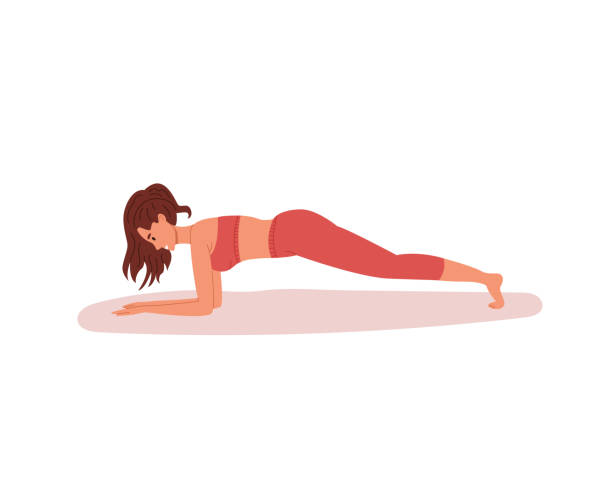
Plank Pose
Core Shoulders Glutes Arms
Why it matters
Every other exercise on this list gets harder without a strong plank. It's the foundational core move — not just for yoga, but for posture, lower back health, and daily functional strength. A 2025 Apollo Hospitals survey found that 62% of Indian women working desk jobs report chronic lower back discomfort. The plank is preventative care.
How to do it
Start on your hands and toes, arms shoulder-width apart. Your body forms a single straight line from crown to heel. Engage your core, squeeze your glutes, keep your hips level. Hold for 30–60 seconds. The temptation is to let your hips rise or sag — resist both.
Build it
Start at 20 seconds if needed. Add 5 seconds each session. When 60 seconds feels easy, progress to forearm plank with leg lifts.
What to wear
To get the most out of this pose, wear tights that offer stretch, support, and stay put as you hold tension through your core. Look for high-waisted fits and breathable, sweat-wicking fabric that won’t shift or distract you mid-hold.
Flurr’s women’s tights are built to handle exactly this — giving you the freedom to move while keeping everything in place.
Shop Tights →
02
Chaturanga Dandasana
Triceps Chest Core Shoulders
Why it matters
Chaturanga is yoga's push-up — except harder. It demands full-body alignment while building significant upper body strength. Most women skip it or drop their knees too early. Don't. This is where real arm and shoulder tone comes from, and it's more accessible than it looks once you learn the mechanics.
How to do it
From Plank, shift your weight slightly forward over your fingertips. Bend your elbows, keeping them close to your ribs — not flared out. Lower your body halfway to the floor, maintaining a rigid core. Elbows at 90 degrees. Hold for one breath, then push into Upward Dog or release to the mat.
Common mistake
Letting the elbows wing out. If that's happening, the weight is too much. Drop to your knees and build up. Form is the entire point here — a sloppy Chaturanga builds nothing except bad habits.
03
Warrior II
Quads Glutes Hip abductors Shoulders
Why it matters
Warrior II is deceptively challenging. Hold it for 45 seconds each side and you'll feel it in your quads, glutes, and hips in a way that rivals a squat hold. It also builds shoulder endurance — arms extended at shoulder height for that long is harder than it sounds.
How to do it
Step your feet wide apart. Turn your right foot out 90 degrees, left foot in slightly. Bend your right knee until your thigh is parallel to the floor — or as close as you can get. Extend your arms out to either side at shoulder height, palms facing down. Gaze over your front hand. Hold. Switch sides.
Key check
Front knee tracks directly over your ankle — not caving inward. If your knee collapses, your hip abductors are telling you something. This is exactly why the pose matters. On rest days, Flurr's flare pants are worth keeping in the rotation — the same relaxed fit that works post-practice works at your desk.
04
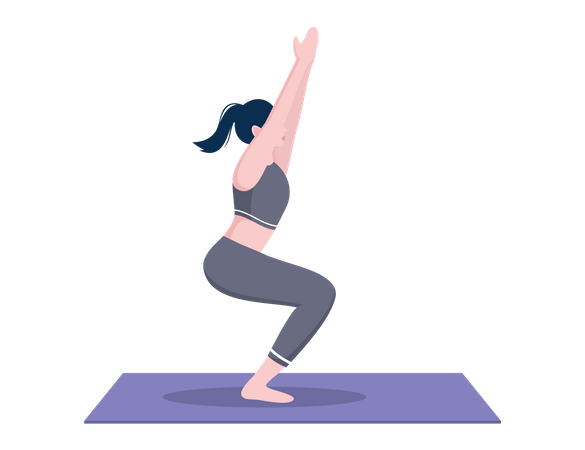
Chair Pose (Utkatasana)
Quads Glutes Core Calves
Why it matters
Chair Pose is a sustained squat hold — which means it taxes the quads and glutes in the same way a loaded squat does, just without the barbell. Held for 45–60 seconds, it's genuinely difficult. It also trains you to sit back into your hips rather than loading your knees, which carries over into every other lower-body exercise.
How to do it
Stand with feet hip-width apart. Bend your knees and lower as if sitting into a chair behind you. Arms reach up alongside your ears, biceps framing your face. Keep your torso upright — don't fold forward. Hold for 30–60 seconds, breathing steadily. Your thighs will complain. That's the point.
05
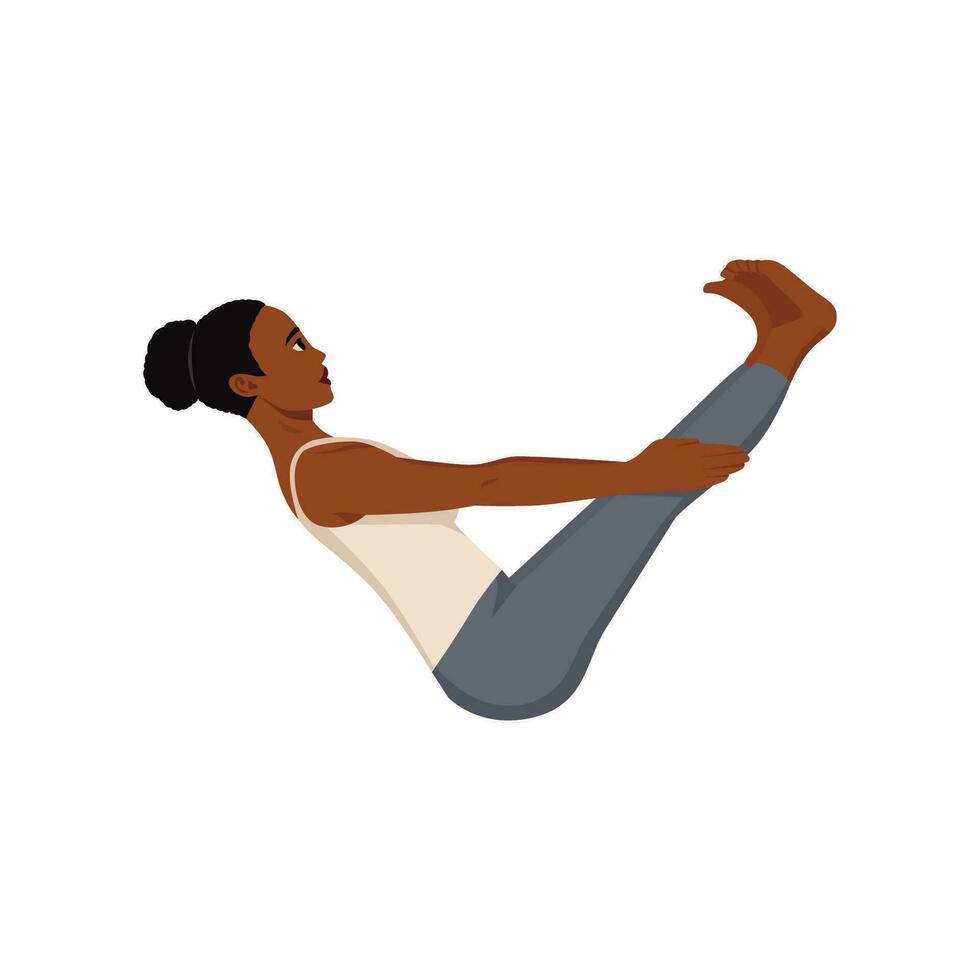
Boat Pose (Navasana)
Deep core Hip flexors Spine stabilisers
Why it matters
Boat Pose doesn't just work your abs — it targets the deep stabiliser muscles that support your spine and pelvis. These are the muscles that protect you during deadlifts, during squats, and during six hours at a desk. Build them here and they show up everywhere else.
How to do it
Sit on the floor with knees bent. Lean back slightly, lift your feet until your shins are parallel to the floor. Extend your arms forward at shoulder height. For the full pose, straighten your legs. Hold for 20–40 seconds. Lower and repeat 3–5 times. Your lower abs will be doing all the talking.
Modification
Keep your knees bent if straight legs aren't available yet. The depth of the fold matters less than keeping your spine long and your core actively engaged. For shorter sessions or warm-up flows, compression shorts give you the freedom of movement without overheating.
06
Downward Dog (Adho Mukha Svanasana)
Hamstrings Shoulders Upper back Calves
Why it matters
Downward Dog is the transition that connects everything else in a yoga sequence — but held actively for 45 seconds, it's a legitimate shoulder and upper back strengthener. It also lengthens the hamstrings and calves, which for women who sit most of the day means it's also reversing the damage of the desk.
How to do it
Start on hands and knees. Tuck your toes and push your hips up and back, forming an inverted V. Press through your palms, push your chest toward your thighs, and work your heels toward the floor. Keep your spine long — don't let your upper back round. Active hands, active shoulders. Hold for 30–60 seconds.
WHAT TO WEAR
This pose demands both stretch and upper-body support, so opt for a well-fitted, non-restrictive sports bra that stays secure through holds and transitions. Pair it with flexible, breathable bottoms that allow full range of motion without slipping.
Flurr’s sports bras are designed to give you that balance of support and comfort — so you can focus fully on your form.
Shop Sports Bras →A 20-Minute Routine You'll Actually Do
Theory is easy. Structure is what gets you on the mat. Here's a complete 20-minute routine built around these six poses — no equipment, no studio, no commute.
The 20-Minute Strength Flow
Warm-Up — 5 min
Cat-Cow stretches1 min
Downward Dog — walk your heels1 min
Low lunge, each side30 sec each
Sun salutation A × 2 rounds2 min
Strength Flow — 12 min
Plank hold45 sec
Chaturanga × 6 repscontrolled
Warrior II, right side45 sec
Warrior II, left side45 sec
Chair Pose45 sec
Boat Pose × 4 holds30 sec each
Downward Dog — active hold45 sec
Cool-Down — 3 min
Seated forward fold1 min
Supine twist, each side30 sec each
Savasana1 min
Do this three to four times a week. You'll notice the difference in your core within two weeks and in your posture within four. Add our Flurr Activewear Collection on gym days, and you’ve got a routine that actually works.
Four Mistakes That Kill Your Progress
Rushing the holds.
Strength comes from time under tension. A 20-second Warrior II does almost nothing. A 45-second one transforms your legs. Slow down.
Skipping core engagement.
In every single pose on this list, your core should be actively on. Not braced for impact — engaged and controlled. If it isn't, the pose is working around your weakness, not through it.
Ignoring rest days.
Muscles strengthen during recovery, not during the session. Three quality sessions with rest beats five sloppy ones every time.
Training in the wrong gear.
Tights that roll down mid-plank or a sports bra that doesn't hold aren't a minor inconvenience — they actively disrupt your focus and range of motion. Explore Flurr's high-waist yoga tights built for full-range holds.
Frequently Asked Questions
How often should women do yoga for strength results?
Three to four sessions per week is the evidence-backed sweet spot. The 2025 WHO physical activity guidelines recommend muscle-strengthening activity at least twice a week for measurable health outcomes — yoga counts. If you're new, start with two sessions and add a third when it feels sustainable rather than forced.
Will strength yoga make women bulky?
No. Yoga builds lean muscle tone — the kind that changes your silhouette and improves how you move, not your overall size. Women have significantly lower testosterone than men, which limits the kind of muscle hypertrophy most people associate with "bulking." What yoga actually does: increase definition, improve posture, and build the kind of visible tone that comes from consistent, controlled effort.
Which style of yoga is best for building strength?
Power yoga, Ashtanga, and Vinyasa Flow are your strongest options — all three emphasise sustained holds and strength-based transitions. Hatha yoga is slower but still builds significant strength if poses are held actively. Avoid purely restorative practices if strength is the goal; they serve a different purpose.
What should I wear for strength yoga?
High-waisted compression tights that don't roll down, and a sports bra that stays in place through inversions and forward folds. For lower-body poses like Warrior II and Chair, you want tights with real compression and enough stretch for a full squat depth. Flurr's tights collection is built exactly for this — full range of motion without the roll-down.
How long before I see results from yoga?
Neurological changes — your muscles getting more efficient — happen within two to three weeks. Visible changes in tone and posture typically emerge after six to eight weeks of consistent practice. A 2025 meta-analysis in Sports Medicine confirmed that women see measurable strength improvements after just four to six weeks of structured yoga practice — faster than most expect. Track your hold times and the number of Chaturanga reps. Progress here is very visible.
The Takeaway
Yoga for strength isn't a soft option. Held properly, with full muscle engagement and progressive overload of time, these six poses build real, lasting, functional strength — the kind that shows up in your posture, your energy, and every other form of exercise you do.
The practice works best when everything around it supports it. That means sleep, nutrition, recovery — and gear that moves with you rather than against you. Uncomfortable tights that distract you mid-hold or a sports bra that slips aren't small problems. They cost you focus, and focus is exactly what this practice requires. Browse the full Flurr activewear collection and pick what moves with you.
Move like you mean it.
Flurr activewear is built for full range of motion — from a 45-second Warrior II to a Boat Pose hold to the walk back to your desk.
Shop the Activewear Edit →


